
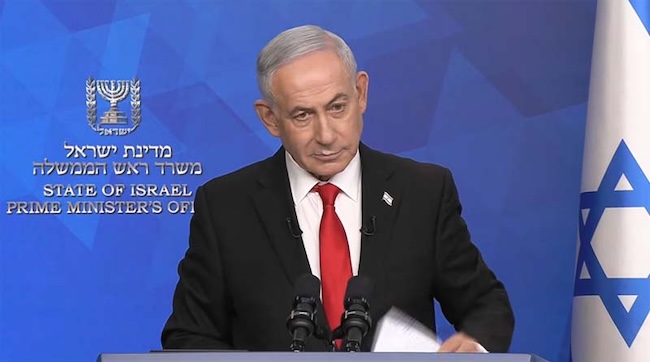
Prime Minister Benjamin Netanyahu hailed the US-brokered agreement signed between Israel and Lebanon in a broadcast news conference immediately after the conclusion of Shabbat on Saturday night.
Speaking to reporters, Netanyahu said “a framework of understandings” was reached that “allows us to move toward ending the conflict and, with God’s help, later reach a peace agreement between the two countries.”
Under the agreement, “the United States and Lebanon recognized Israel’s right to maintain a security zone until no threat is posed to Israel from Lebanon,” he said. “This is a major blow to Iran and Hezbollah, and to Iran, which tried to force us to withdraw from south Lebanon,” Netanyahu noted.
The prime minister pointed to the security zone in southern Lebanon on a map depicting the “yellow line” that marks the border of the newly created buffer area.
“I want to remind you what was in Lebanon. Hezbollah had 150,000 missiles and rockets. And we eliminated about 90% of this huge stockpile,” Netanyahu said. “We shocked them with beepers, we eliminated Nasrallah, we killed the commanders of the Radwan Force. Just in the last two weeks we killed more than 200 terrorists.”
AFSI Insight
This agreement is less a Lebanon-Israel bilateral breakthrough and more a setback for Iran’s regional “proxy axis,” particularly its it affects its influence through Hezbollah. Netanyahu’s characterization of the deal as a “major blow” to Hezbollah is evidence that Iranian-backed deterrence structures are eroding. While acknowledging the agreement as “historic” in form, any diplomatic framework is only meaningful insofar as it preserves Israel’s right to defend itself and does not constrain IDF operations. The deal is a positive strategic development against Iran and Hezbollah, but only insofar as it does not limit Israeli military freedom or compromise long-term security control in the north.