
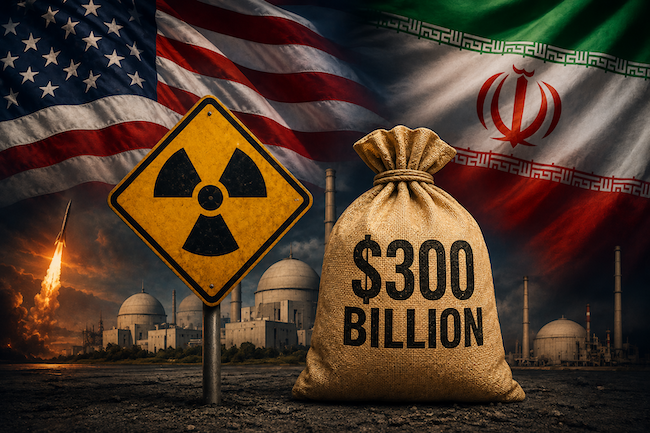
The U.S.-Iran Memorandum of Understanding (MOU) establishes a 60-day ceasefire, reopens the Strait of Hormuz, and offers sanctions relief and a potential $300 billion reconstruction package if a final agreement is reached.
President Donald Trump and Vice President JD Vance signed the accord electronically this past Sunday, with a formal signing ceremony set for Friday in Switzerland. Vance, Steve Witkoff, and Jared Kushner are expected to represent the U.S.
Major issues, including Iran’s nuclear program, remain unresolved and will be addressed in future negotiations. Trump warned that any Iranian violation of the agreement would trigger renewed U.S. military action.
AFSI Insight
We view the reported U.S.-Iran Memorandum of Understanding with deep concern as it rewards the Iranian regime with massive economic and diplomatic concessions while leaving critical security threats unresolved. Clause 10 of the MOU allows for the Iranian sale of oil and permits all banking transactions, etc. that go along with such commerce upon the signing of the MOU. This has always been the primary source of funds for the IRGC and will give it an immediate financial reward. Clause 11 includes an undertaking by the US to make fully available frozen or restricted funds again upon the signing of the MOU. A bonanza! This is all in exchange for Iranian commitment to negotiate a final agreement that will be difficult to verify and enforce.
Iran has a long history of violating international commitments and using periods of negotiation to strengthen its regional position. Providing sanctions relief before Iran has demonstrably dismantled its nuclear capabilities, ended support for terrorist proxies, and abandoned its genocidal threats against Israel risks repeating the failures of past agreements.
We are also troubled by reports that the memorandum focuses heavily on future negotiations while leaving major concerns—including Iran’s sponsorship of terrorism, ballistic missile development, and support for Hezbollah and other proxy forces—largely unresolved. It does call for the immediate cessation of hostilities in Lebanon but does not preclude the regime from funding its proxies. They will enjoy some sanctions relief merely for reopening the Strait of Hormuz and as money is fungible, they can easily use it to support their terror network. Any agreement must prioritize Israel’s security and ensure that Iran cannot use new financial resources to expand its regional influence.
Lasting peace and stability cannot be achieved through economic incentives alone. It is unlikely that this regime will ever want to exist in cooperation with the US and Israel. Instead, Iran must face sustained pressure until it verifiably abandons its nuclear ambitions, ends support for terrorist organizations, and ceases its threats against Israel and the broader free world.
In summary, the MOU serves merely as a framework for discussions throughout the ceasefire period. The Islamic Republic can declare victory – for them, survival is victory. Agreements and “Memos” aren’t worth the paper they’re written on. We pray this isn’t as big a mistake as it appears to be.