
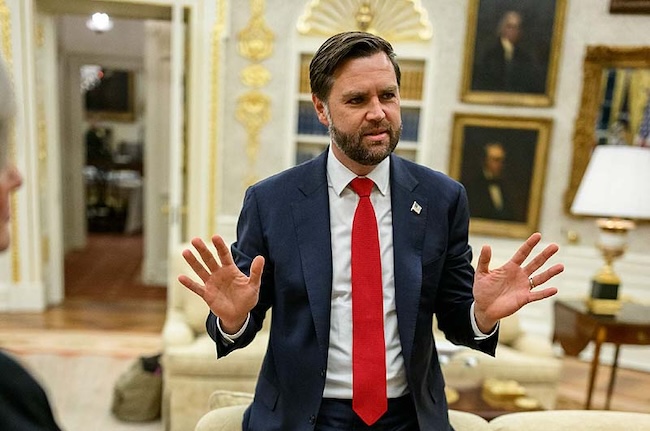
Vice President JD Vance said on Sunday that 21 hours of peace talks in Pakistan between the United States and Iran ended without an agreement to stop the war.
“They have chosen not to accept our terms,” Vance told reporters in Islamabad, but stressed that there is still a chance for a deal. “We leave here with a very simple proposal: a method of understanding that is our final and best offer,” he said. “We’ll see if Iran accept it.”
“The bad news is we have not reached an agreement,” Vance said. “And I think that’s bad news for Iran much more than it’s bad news for the United States of America.”
Iran quickly blamed the White House for the failure of the talks. The Tasnim and Fars news agencies, which are linked to the Revolutionary Guards, said the main disagreements were over the Strait of Hormuz and Iran’s “nuclear rights.”
Will the talks with Iran be renewed? Possibly. By early Sunday, three main sticking points remained, according to the NY Times, citing two Iranian officials familiar with the talks: the reopening of the Strait of Hormuz, the fate of nearly 900 pounds of highly enriched uranium, and Iran’s demand that about $27 billion in frozen funds held abroad be released.
AFSI’s take:
Given a negotiation partner such as the Islamic Regime in Iran, we did not anticipate that an agreement would be achieved. They are unlikely to relinquish their enriched uranium, and their aspirations regarding nuclear capabilities continue to be significant. Hardliners continue to hold power, even though there is no definitive indication of who is at the helm of the regime. Without a complete change in the regime, it is uncertain how much longer further negotiations can persist. The subsequent action is yet to be determined.
Source:
After 21 Hours, Vance Walks: No Iran Deal, by David Israel/The Jewish Edition, April 12, 2026