
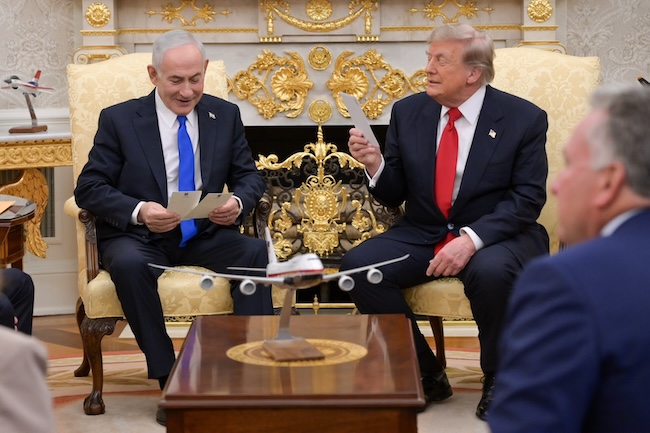
The meeting between Prime Minister Benjamin Netanyahu and President Donald Trump, which ran a little over an hour, ended shortly before 12:30 pm ET with no remarks to the media. No media were allowed into the Oval Office.
The high-stakes meeting began about an hour after its scheduled time, following Trump’s meeting with Ukraine President Volodymyr Zelenskyy. All senior Trump administration officials were on hand, including Vice President JD Vance, Secretary of State Marco Rubio, War Department Secretary Pete Hegseth, CIA Director John Ratcliffe and Special Envoy Steve Witkoff.
White House Press Secretary Karoline Leavitt told reporters that the Trump-Netanyahu meeting, was “positive and productive.” But she offered no details about the content of the meeting with Israel’s prime minister.
Netanyahu told reporters prior to his departure from Israel that Iran would top the agenda for the meeting.
AFSI Insight
Despite the absence of cameras, a joint press conference, or an official statement, the most significant outcome of the Trump-Netanyahu meeting appears to be what didn’t happen: there was no public rupture in the U.S.-Israel relationship. Reports following the closed-door discussions described the meeting as “positive and productive,” with both leaders reaffirming their shared commitment to preventing Iran from obtaining nuclear weapons. They also discussed expanding the Abraham Accords and addressing security challenges in Lebanon and Gaza.
For AFSI, the most important takeaway is that Israel’s security concerns remained front and center. Iran continues to be recognized as the primary strategic threat, and both leaders reportedly reiterated their determination to ensure that the Islamic Republic never becomes a nuclear power. At a time when diplomacy with Tehran remains uncertain, maintaining this united objective is critical for Israel’s future.
The meeting also suggests that despite reports of disagreements over tactics and regional diplomacy, the U.S.-Israel alliance remains firmly rooted in shared strategic interests. Quiet diplomacy often produces more meaningful results than public declarations, and AFSI hopes that this private discussion will translate into stronger American support for Israel’s security, greater regional normalization through the Abraham Accords, and continued recognition that Israel—not international pressure—must determine how best to defend its citizens.