
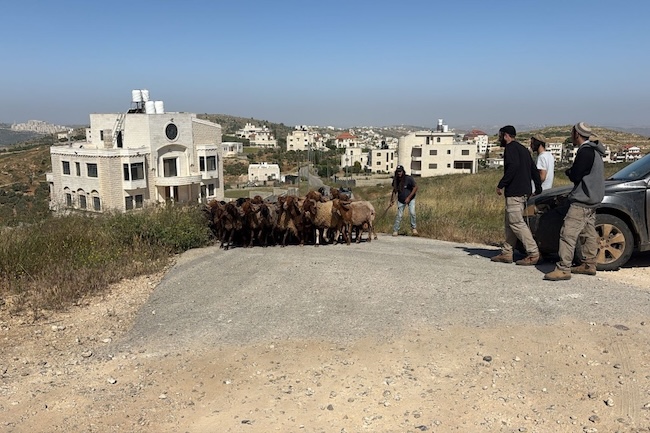
According to the United Nations Office for the Coordination of Humanitarian Affairs (OCHA), around 100 Israeli “settlers” raided four Palestinian communities, attacked residents with knife-tipped sticks, stole roughly 300 sheep, burned three tons of firewood, vandalized homes and vehicles, and injured six Palestinians.
According to military messages, radio communications, and field material reviewed by The Press Service of Israel (TPS-IL), the incident began when Palestinians from Halawa, one of the communities in Masafer Yatta, attacked a Jewish shepherd with rocks, injured him, and stole his flock. Israeli forces later searched the area and recovered the animals, according to a TPS-IL review of military communications.
Over several months, TPS-IL reviewed incidents listed by OCHA in its humanitarian reporting on Judea and Samaria between January and May 2026, comparing the UN agency’s descriptions with Israeli military accounts, public statements, local documentation, media reports, and interviews with Israeli researchers and activists.
AFSI Insight
This report exposes a serious flaw in the UN’s portrayal of violence in Judea and Samaria. OCHA’s broad definition of “settler violence” can include Palestinian attacks on Israelis, disputed incidents, and even nonviolent activity—while these cases are then used to create the misleading impression of widespread Jewish “settler violence.”
AFSI has long warned that international bodies frequently accept Palestinian claims at face value while minimizing or obscuring Palestinian aggression against Jews. The Masafer Yatta case is particularly troubling: an incident recorded by the UN as a large-scale “settler” attack was preceded, according to Israeli military communications reviewed by TPS-IL, by Palestinians attacking a Jewish shepherd and stealing his sheep.
The implications go well beyond statistics. These questionable figures are cited in international discussions about sanctions, diplomacy, and policy toward Israeli communities in Judea and Samaria. AFSI believes that distorted data must not be allowed to drive policies designed to delegitimize Jewish communities or undermine Israel’s rights in its historic homeland.
Bottom line: Before accepting UN statistics about “settler violence,” the underlying incidents, methodology, and competing accounts must be examined. Accuracy—not politically convenient narratives—should determine the international record.